
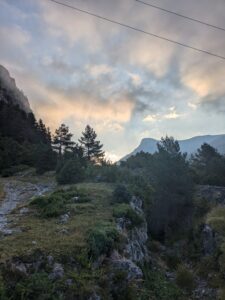
Day seven started out pretty great, on the top of a mountain that had been fully covered in clouds the evening before. At 7 am, when I left the hostel to start the day’s hike, the sun was rising on one side of the mountain tops, and the other one was slowly revealing itself from behind white, puffy clouds. Despite my early start, I quickly lost minutes due to stopping every five steps to look up and admire my view. Day 7 is a rough day in numbers, with 30 km to its name and the 800m elevation gain from the day before in the opposite direction. Never have I ever been so happy for the existence of my hiking poles, because I would surely have broken a bone during the downwards stretch without them. The good thing about having hiking poles, however, is the fact that you can really commit yourself to the bit, practically throw yourself off the mountain hill and just catch your body with the ingenious sticks before you roll an ankle. Whoever wants to tell me that that is not why hiking poles were invented, clearly never tried to go down a mountainside at full speed. I was making good time, going down the mountains like a lunatic and taking a moment every now and then to admire the sunrise. Until I came eye to eye with my nemesis.
(Seriously, WHY do their horns have to be so pointy? Why??)
As if the Universe wanted me to face my fears, I suddenly came eye to eye with an entire herd of horned, moo-ing cows that were walking my way. So, I did what any sane person would have done, and hid behind a tree. For thirty minutes. Just waiting for the herd to pass. Cows walk so damn slow. If you thought my speed going down the mountain was special, you should have seen how fast I was walking when I finally found a gap in the herd that was large enough for me to make it to the gate of the cow field. The rest of the twenty kilometres towards Jaca were largely unremarkable, filled with dusty rocks and long stretches next to the road with barely any shade.
Jaca is a big city, and the amount of people walking through its streets created a bit of a culture shock. A little less than 10 km out of the city, I started feeling a searing pain in my right knee, and I had slowed down to give it some reprieve. There was a part of me that was still pushing to get to the albergue out of fear of not having a place to sleep*. When I arrived, however, I was shown to a room with fifteen beds, of which only one was occupied. I went through my usual arrival-routine of unpacking, showering and washing my clothes, but when I left the shower the pain in my leg had almost tripled. The nagging sensation that had been keeping me company for the last kilometres had turned into piercing, burning pain that made me grit my teeth every time I took a step. Now there’s this word on the camino, Ultreia, and it means ‘go forward’. It’s a pretty good one to describe the camino, because your entire purpose becomes going forward. Even if your knee feels like it’s kind of being ripped apart from the inside out, you go forward (albeit slowly). So I massaged it out as much as I could, and then started a slow tour of the city to keep my muscles from completely seizing up. No point in panicking about tomorrow if tomorrow isn’t there yet.
*just the mere thought of the hostel being full made me want to cry.

You have to know, I don’t like churches. Or rather, I like the physical buildings, but I have more complicated relationship with the institute behind it, mostly because of their rigid stance of life, and constant insistence claiming that we are not ‘worthy’. I like feeling worthy. And I like feeling accepted. So, when I sat in that church and I enjoyed the peace, I was also feeling some lingering resentment – which killed the mood more than a little. But, hey, I’m on this camino to change, and even though changing my stubborn anger towards the Catholic church firmly wasn’t on my list, I might as well try, right?
And so, with my head still tipped back and my eyes still closed I started… talking. Not praying, per say, but just talking. About how I believe in the essence of it all, in love and trust. And that I can look past all the words and rules that people made up and called ‘religion’, and that I would like to get a little back-up on my trip because some extra protection never hurt anyone. And then I put my hands on my knee (and writing this sounds a little unhinged but you’ll just have to take my word for it), and my mind stilled. I must have sat there for ten, fifteen minutes, with my eyes closed and my hands on my knee. When I woke up the next morning, the pain in my knee was gone. Which was absolutely amazing, because after Jaca, there were two options: continue on the camino, or do a 24 km, history-filled detour. You can guess which one I choose.
Before I started walking I decided to have a little breakfast with Emmanuelle, a woman I met at the hostel. My original plan was to leave at 7 in the morning, but after the push of the day before, I quite liked the idea of switching to a lower gear and just having a slow day. I had already booked a hotel for two nights in Santa Cruz de las Serós, so I didn’t have to get to an albergue at a certain time, and I could just enjoy my time. So we took it slow, and by the time the two of us made it downstairs, the albergue was practically deserted. There was only one other pilgrim still hanging around, who turned out to be quite a familiar face. Jordi had gone down the somport in two stages, so I had unknowingly caught up with him. He, too, was going to the monasteries, except he’d be taking a bus and I would go there on foot. Jordi joined us for breakfast – churros, chocolate sauce and orange juice – and then we were off.
The path to San Juan de la Peña is actually one that is not very advertised, because it goes up quite a lot and I don’t know what is going on with the sign situation but it seems like some of the yellow arrows had a midlife crisis. By the time I was halfway to the first monastery, I had taken a break approximately three times to catch my breath, and had fallen back on the good old stone heaps to find the way because the arrows were unreliable and tended to send me straight through dry riverbeds that were usually overgrown with thorny bushes. However, all of this was absolutely worth it, because the incline was insanely steep and the path was slippery, but the view was incredible. ‘The balcony of the Pyrenees’, they call it. I love being high up in nature. I’ve always felt like I belong in places like that. I don’t know what I want in my future, but I do know one thing: I need to have a good view, one that’s high up on a hill or a mountain. After the balcony, the path followed the road for a few more kilometres, until eventually it led into a forest. At the very end of it, a set of wooden doors rose up through the tunnel of trees, almost as if I had been transported into a fairy tale. The best part was that when I entered the information centre, a second familiar face greeted me, and I felt overcome with joy to see Sophie and Alan back. All day I had been wondering where they were and how they were doing and suddenly they were just right in front of me. Funnily enough, Sophie had the exact same reaction when she saw me. They treated me to an ice cream, and this time when we said goodbye it was final. They were taking a bus back to Jaca in the evening because it was the end of their trip. Nevertheless, getting to see them back pretty much made my day.
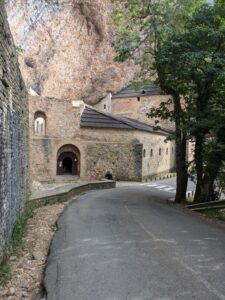
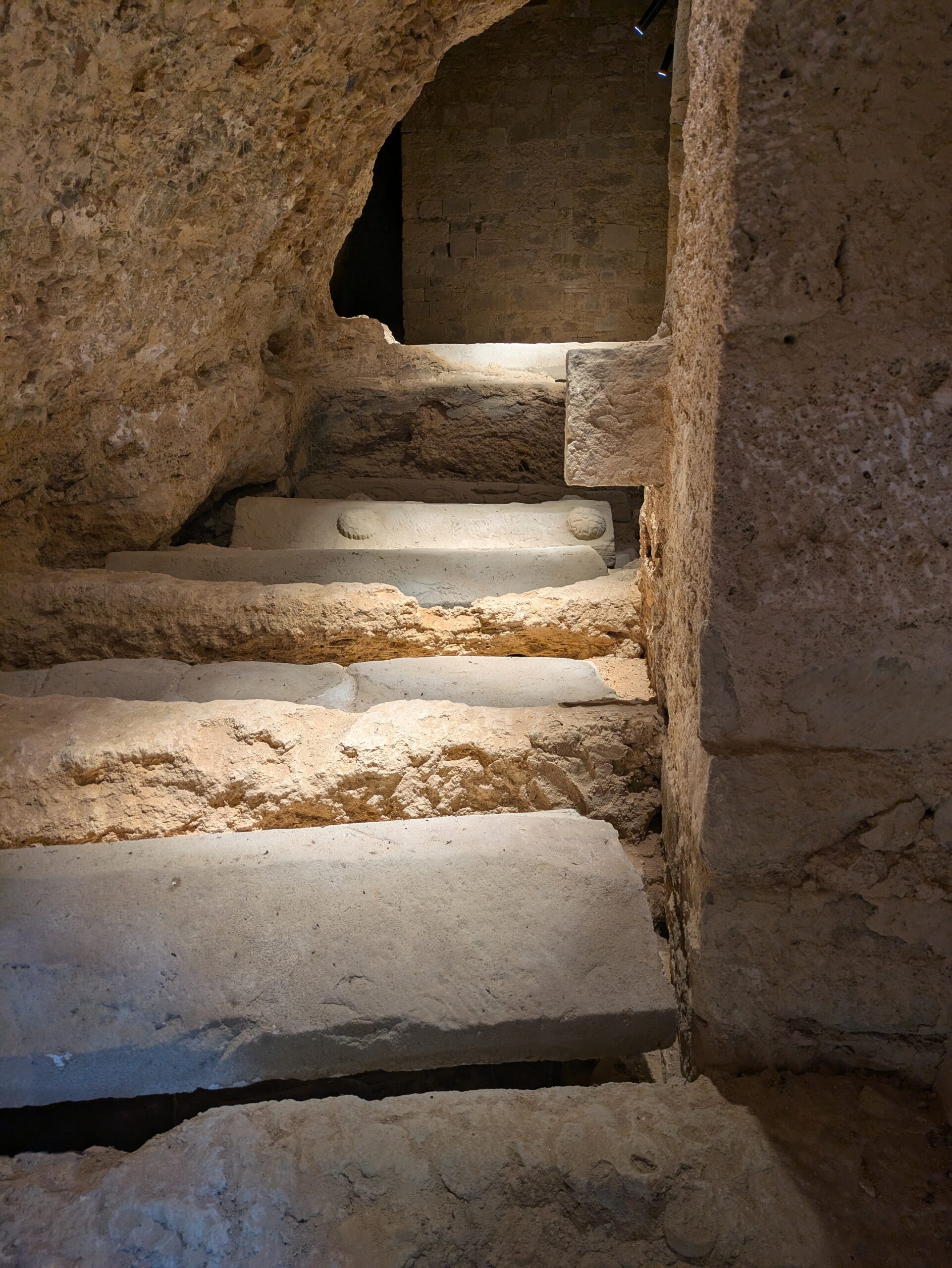
The first monastery that I saw wasn’t actually the original monastery of San Juan, but the younger version that was built a few centuries later, after the original monastery had caught fire one too many times. Said older monastery could be found a few kilometres lower on the hill, and is quite famous for the fact that it’s built into a rock. Not underneath, not next to, but into. There’s a very long and detailed legend about why the monastery was built there, something involving a dead person (as usual), and some people from royal bloodlines finding the dead person, but the point is that at the beginning of the 10th century a royal monastery was built and dedicated to San Juan. It served as an important building for the young kingdom of Aragon. In its early years, it was said to have been housing the Holy Grail, and the first kings of Aragon were even buried there. Now, you have to realise, I love many things but my love for history cannot easily be trumped. One of the coolest things, in my opinion, is seeing the traces of people who lived centuries before us, and one of the most physical examples of this is burial places. So, yes, I stood there gawking at a bunch of Extremely Old Coffins for at least five minutes. Sue me. The people behind me probably thought I was either insane or practising necromancy. Or both.

After an hour and a half of internal freaking and swooning over a heap of old stones, I came to the realisation that:
- I only had an hour left to get to my hotel and
- the calculation I had done of needing 45 minutes to walk 3km was incorrect according to the sign, which cheerfully stated it would take me 1 hour and 15 minutes.
Looking back on it, I probably should have just called the hotel and told them I’d be late, but also I am very new at this adult thing so you have to forgive me for not doing that and taking out the good old hiking poles instead. It took me 35 minutes. The entire run/walk/jump down the hill, I looked like I was the main character in one of those ‘Don’t try this at home’ videos. Or maybe the ‘Dumb ways to die’ one. Either way, I did make it down the hill safely and well, and with time to spare.
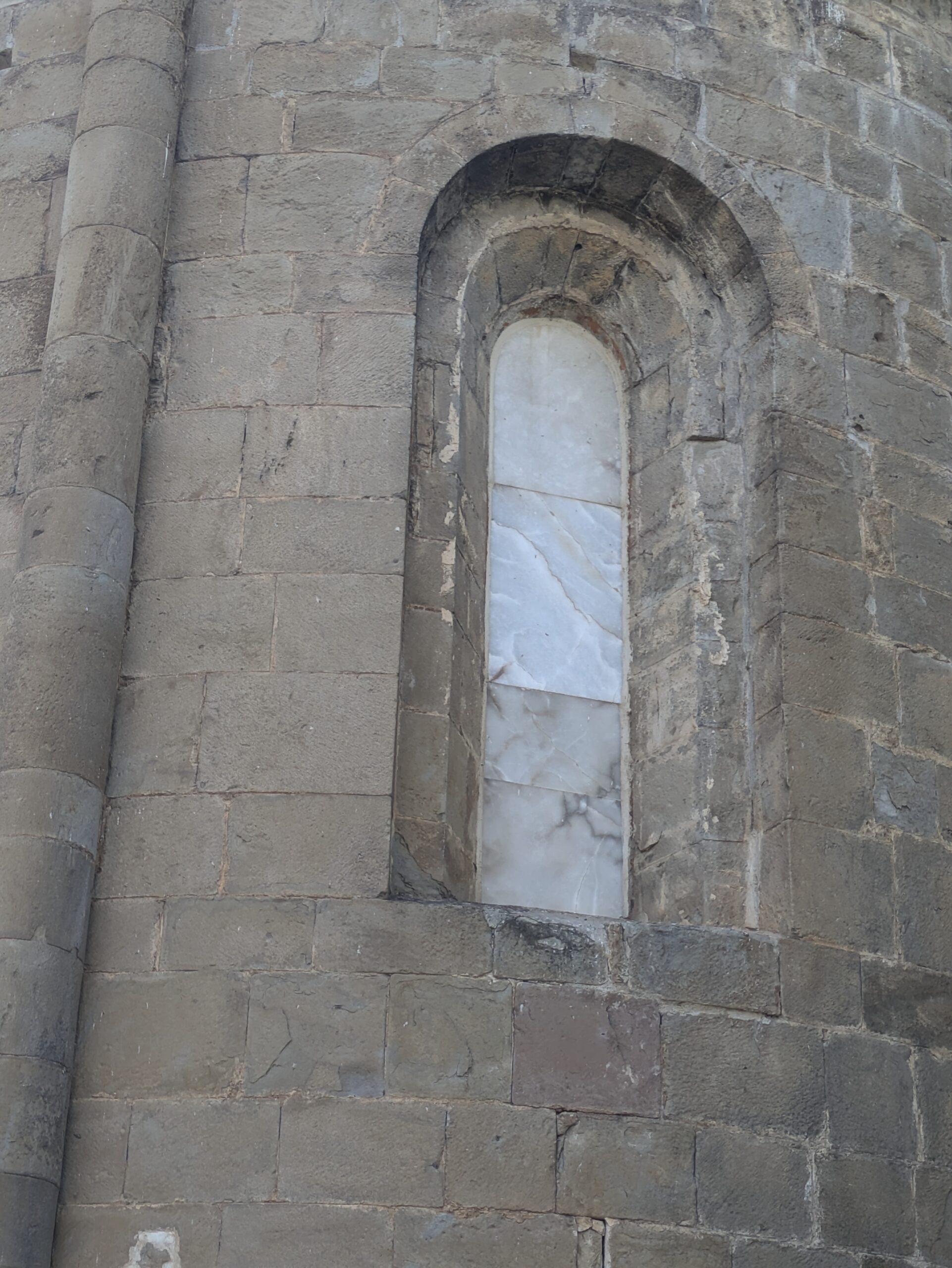
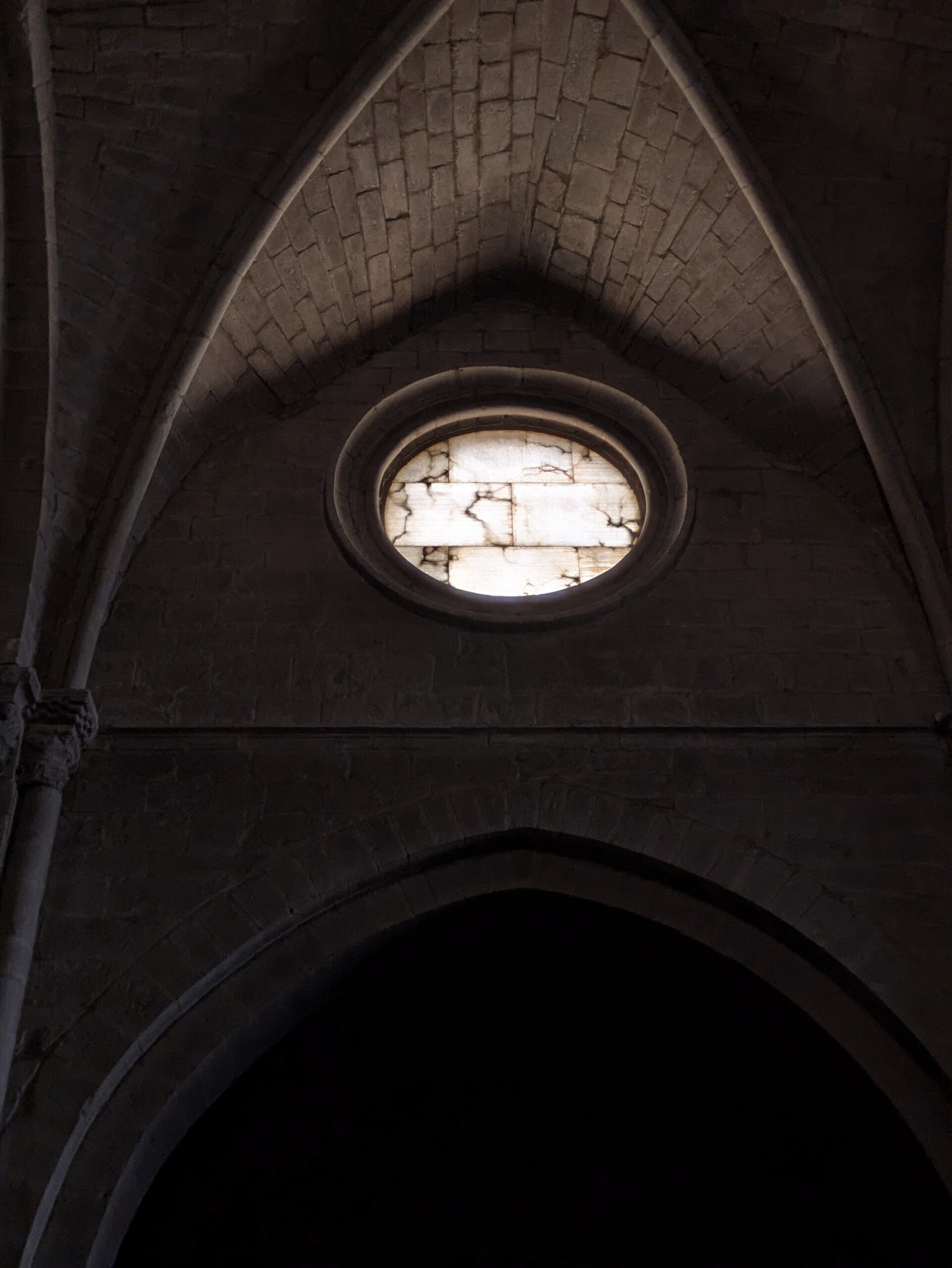
Day nine on the camino was one unlike any others, because I didn’t wake up at 6 am.** I stayed decadently in bed until 11 in the morning, and then spent the first part of the day writing on my balcony. When the sun reached its hottest point, I left the balcony to go visit the church instead, because it was part of the monastery complex and I still had a ticket for it. It’s not that big of a church, until you realise it was built in the 11th century, and that it’s the only surviving part of what once was an entire living complex. What struck me as the most interesting though, were the windows. Generally, when you think of a church window, you think of glass-stained windows, with their colours and pictures. But this church had windows that looked like they were made of something marble-like from the outside. When you went inside though, it filtered the sunlight in, creating soft patterns. I was absolutely enchanted by them. A deep search on the internet only taught me that they indeed existed (something I was very aware of, given that I was looking up at one), but not why they existed. In the end, the receptionist of the church helpfully informed me that, because the church was so old, glass-stained windows didn’t exist yet, and people used alabaster instead.
**addendum from present-day Merel: I can now tell you that sleeping past 6 am feels like something out of a dream, because at this point my body has gotten used to the routine and wakes me up at 6 am without any alarm. I’m looking forward to my next zero day not because there won’t be any kilometres, but just because I’ll get to sleep until, say, 7 for once.
Camino lessons? I want to live somewhere with a nice view, and I want my future home to have alabaster windows. Oh, and I should really learn to call people instead of running down a hill that’s all pebbles and slippery stones. Probably.