
I left Santa Cruz at 9 in the morning. The forecast didn’t look too promising, with a lot of rain and thunderstorms coming in, but only in the afternoon. It wasn’t a big day, 17 km, so I felt quite good about it. Until ten minutes in, when the sky above me started rumbling, and the first raindrops fell down.
Camino lesson: don’t trust Google. The first part of the road to Arrés was barren and hilly, and of course I was nearly on the top of one of those hills when the thunder started. With nowhere to go and no shelter nearby, I eventually opted to sit down in a ditch on the side and wait out the storm. I put the raincover on my backpack, placed it a few feet away from me together with my hiking poles, and then hunched over in my own rain poncho. It was big enough to protect my e-reader as well, and so I simply sat there, on the hill, in a ditch, reading a book while a thunderstorm passed over me. The vibes were immaculate.
I continued on a small thirty minutes later, rushing to get past the hills because the clouds overhead were still kind of rumbling. A few kilometres later I passed through a small city. My original goal was to find a toilet, but I quickly got sidetracked by a cat in the middle of the road. Of course, I sat down on the ground to pet it, and then five more cats showed up so I was kind of in my personal heaven for a few minutes. There were even a few kittens. Talk about amazing. I then continued on, following the yellow arrows and only realised half an hour later I never got around to finding a toilet.

This was only my second hiking day on the Spanish side of the Pyrenees but it was already a stark contrast with the French side. The lush green forests and countless fields were gone, replaced with dry, sandy ground and prickly weeds. Between Santa Cilia and Puente de la Reina de Jaca the path followed the main road, switching sides depending on which one had the most space for a hiker to walk without being in any imminent danger. Right before reaching the second city, however, the path veered off a little bit and trailed down towards the river. I’m not sure how the stones came to be there, maybe the river brought them down, maybe there used to be houses or old buildings. The point is that there, right before arriving at Puente de la Reina de Jaca, there is a part of the trail that is surrounded by stone heaps built by pilgrims. It’s overwhelming, almost, to stand there and take it all in. The heaps are in front of you, behind you, on both your sides, and when you turn around the corner there’s more. I sat down to build my own, and then to take it all in. So many pilgrims who had come before me, who had left a trace behind that they had been here and that I wasn’t alone. It offered a feeling of connection to people I had never met before, people who might have passed by the same road as I did, with the same intentions, hundreds of years ago.
I continued towards Arrés, a small village with maybe twenty houses. The road up there was gruelling, because the actual camino continued onwards while those who stayed overnight in Arres had to veer off to the right and go up a nasty hill that kind of came out of nowhere, in the burning sun. You also can’t see Arrés until the last possible minute, the road making a sudden turn to show the first houses. When I walked up to the albergue, there were already some people sitting outside, and they immediately offered me ice tea and a seat. It was the warmest welcome I’ve had in an albergue*, and the warmth and kindness of the volunteers was so overwhelming that it even threw me off a bit at first. The volunteers were two childhood friends, Juan and Paco, and Paco’s wife. Paco was overjoyed when he learned that I came from Flanders, because he had an inexplicable love for the language. I introduced him to the wonderful song ‘Dos Cervezas’, to which he listened while laughing so hard that he had tears in his eyes. And Juan made me stand up the first time he met me, so that he could give me a hug. “You are home now,” he told me when he let me go. In the evening, we all dined together, the volunteers and six pilgrims. One of them, Mark, had made Mexican food for us. Because it’s a parochial albergue, they try to keep a link with the Catholic religion, and thus Juan explained to us that they would like to hold a prayer before we started eating.
“You all know Queen, yes?” He asked, to which we all nodded. Juan instructed us to create the beat of We Will Rock You by slapping our hands against the table, and then he started rapping in Spanish. I’m not kidding. Imagine this, a small, rickety old building, nine people around a table, drumming the beat of We Will Rock You while they pray.
*addendum from present-day Merel: still now, a good 300 km further down the road, the albergue of Arrés is the most special one I’ve stayed in.

During the dinner, Juan asked us to introduce ourselves by our profession. And once that round was done, he looked at each of us and point-blanked asked, “Now, why are you here?”
Good question, Juan. Good question. To be truthful, up until that moment I had been kind of asking myself the same thing. Sure, I knew I wanted to hike the camino because it would offer something, because I would get to know myself a little better. But why, exactly, did I feel the need to experience that? Why did I feel it was necessary to hike 1000 km in order to get to know myself better? When Juan asked that question, you could see several people at the table inhale deeply. And I realised I knew why I was hiking the camino, that I had known all along. It was quite simple really. So when it was my turn, I told them, “When I was seven years old, my mum got quite sick. She’s way better now, but it still impacts my life nowadays, because seven-year old me got convinced that I had to keep her alive, that I had to keep her safe and healthy, and so I still live my life trying to do exactly that. And in my mind, I always thought we’d hike this one together, my mum and me. So I’m here, I’m walking to stop living for my mum, and to start living for myself. She always tells me that I’m allowed to jump further than her, and that’s what I’m doing.”

The next day led us to Ruesta, the town with the least inhabitants of the entire camino. Which, to be fair, isn’t too difficult considering it’s a ghost town and the only livable house is the albergue. I started the day on my own, and didn’t encounter anyone for the first 10 km of the day. This was exactly what I needed, because my mind had rearranged itself overnight after my answer the evening before, and some quiet and solitude helped me in the process of looking at all my emotions.
Somewhere on kilometre fourteen I also realised that I was having a lot of cramps, and that I had either eaten something wrong or my period had just started. It turned out to be the latter, and let me tell you, I’ve never experienced a discomfort like hiking over 10 km while having period cramps and your hip belt is digging into your stomach. Absolutely horrible experience, 0/10, do not recommend. I would have stopped in the nearest albergue if it weren’t for the fact that the nearest albergue was still a good 14 km away. Fun times.
I eventually made it to Ruesta with the help of Olivier and Joëlle, two French pilgrims I had met the evening before in Arrés. Joëlle was so focused on having a warm shower and a bed that she pushed through the last 10 km in just under two hours. Me and Olivier tagged along, both kind of dying but also refusing to give up because, in my case, I knew that if I would let them go on I would probably go sit on the side of the road and just sleep there.
Ruesta itself is an interesting town to visit, with all its houses in ruins. There’s even an old castle, sitting on the edge of the town and overlooking the valley down below. That same valley is coincidentally the reason for its current status as ghost town, because in the early 1900’s a plan was made to create a reservoir. It was eventually finalised during the era of Franco, and with the creation of the Yesa reservoir the valley – and all the fields it housed – were flooded. The farmers, who lived up on the hill, suddenly didn’t have the means to sustain themselves anymore, and left their towns.
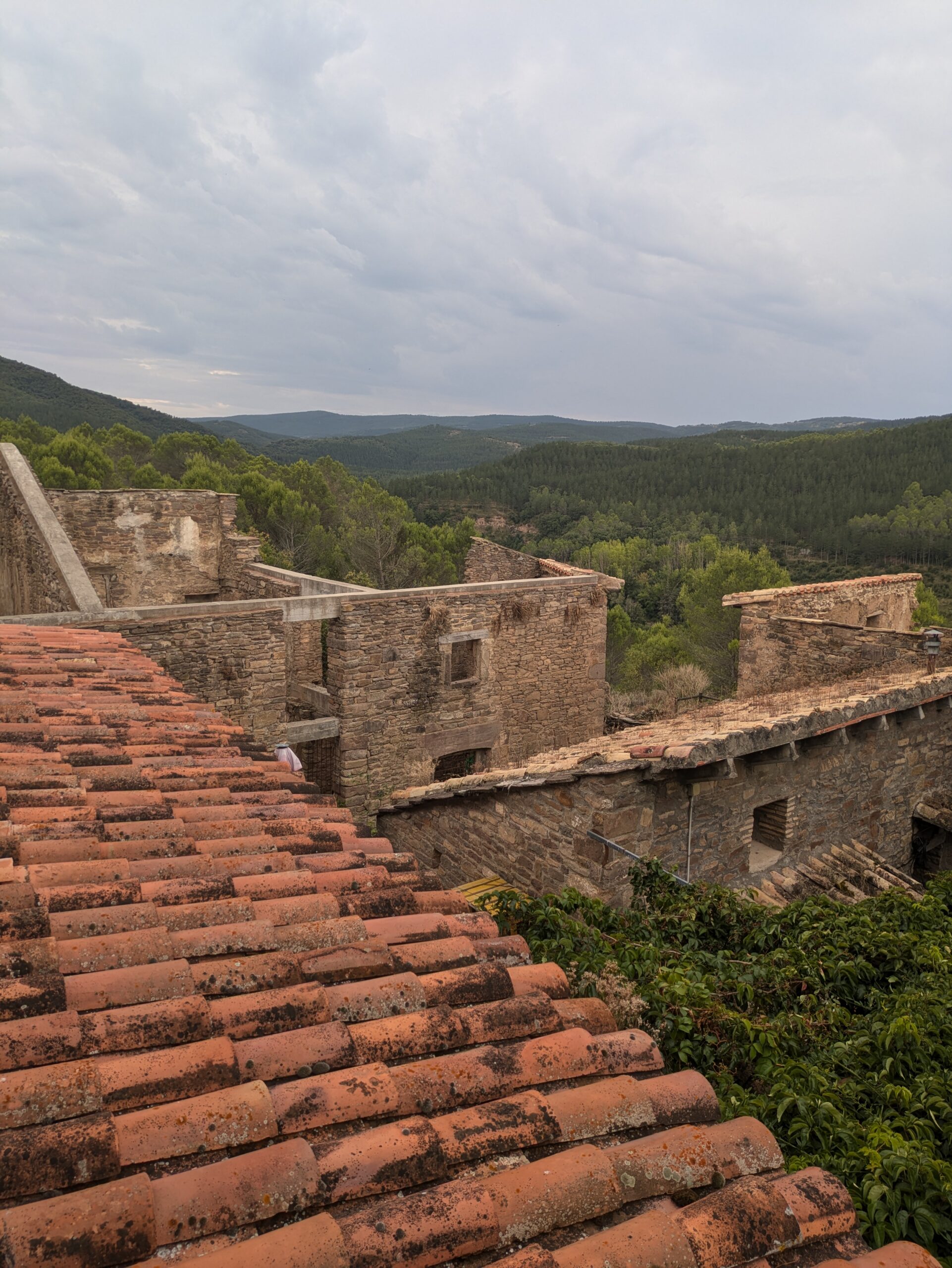
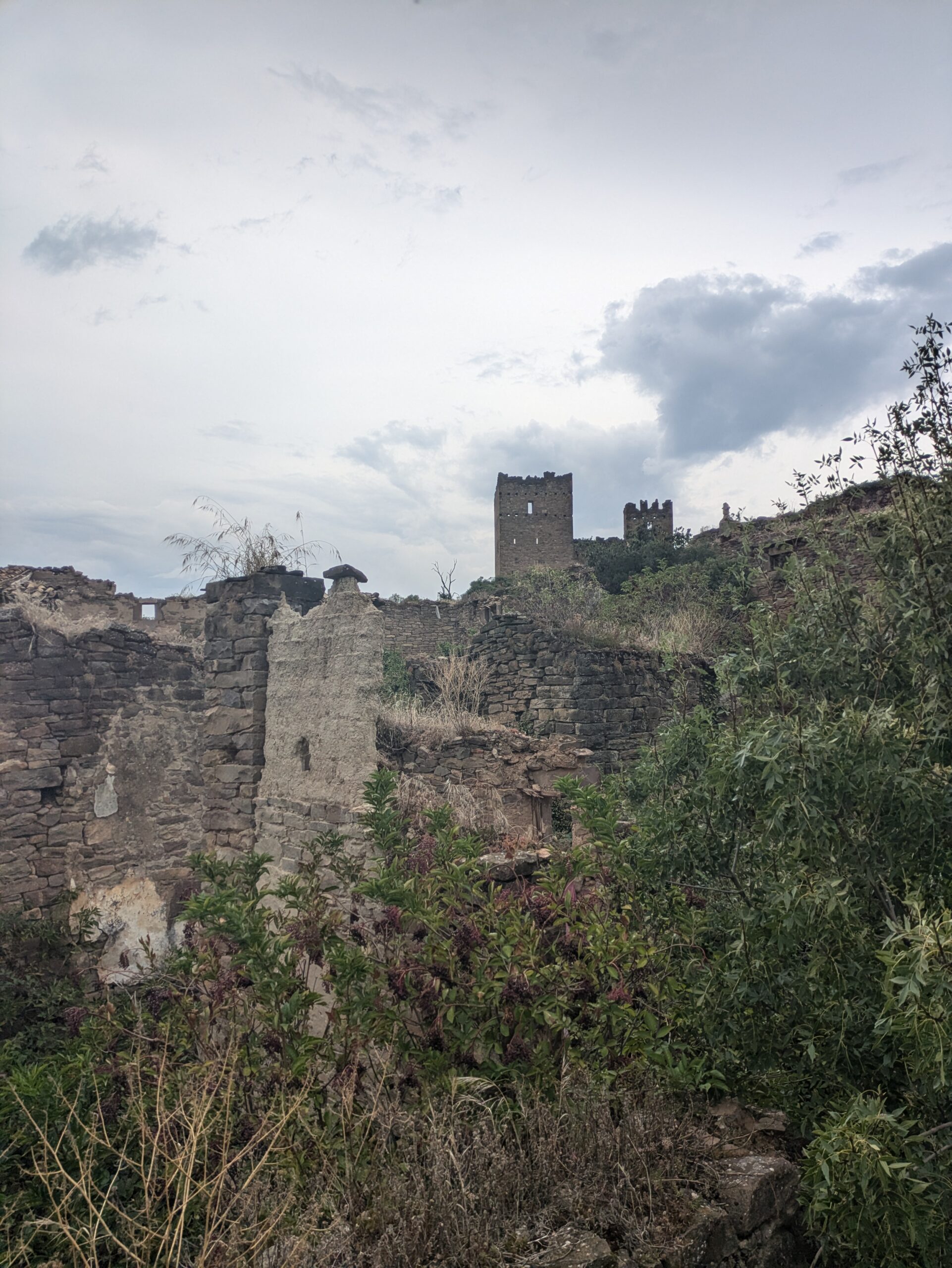
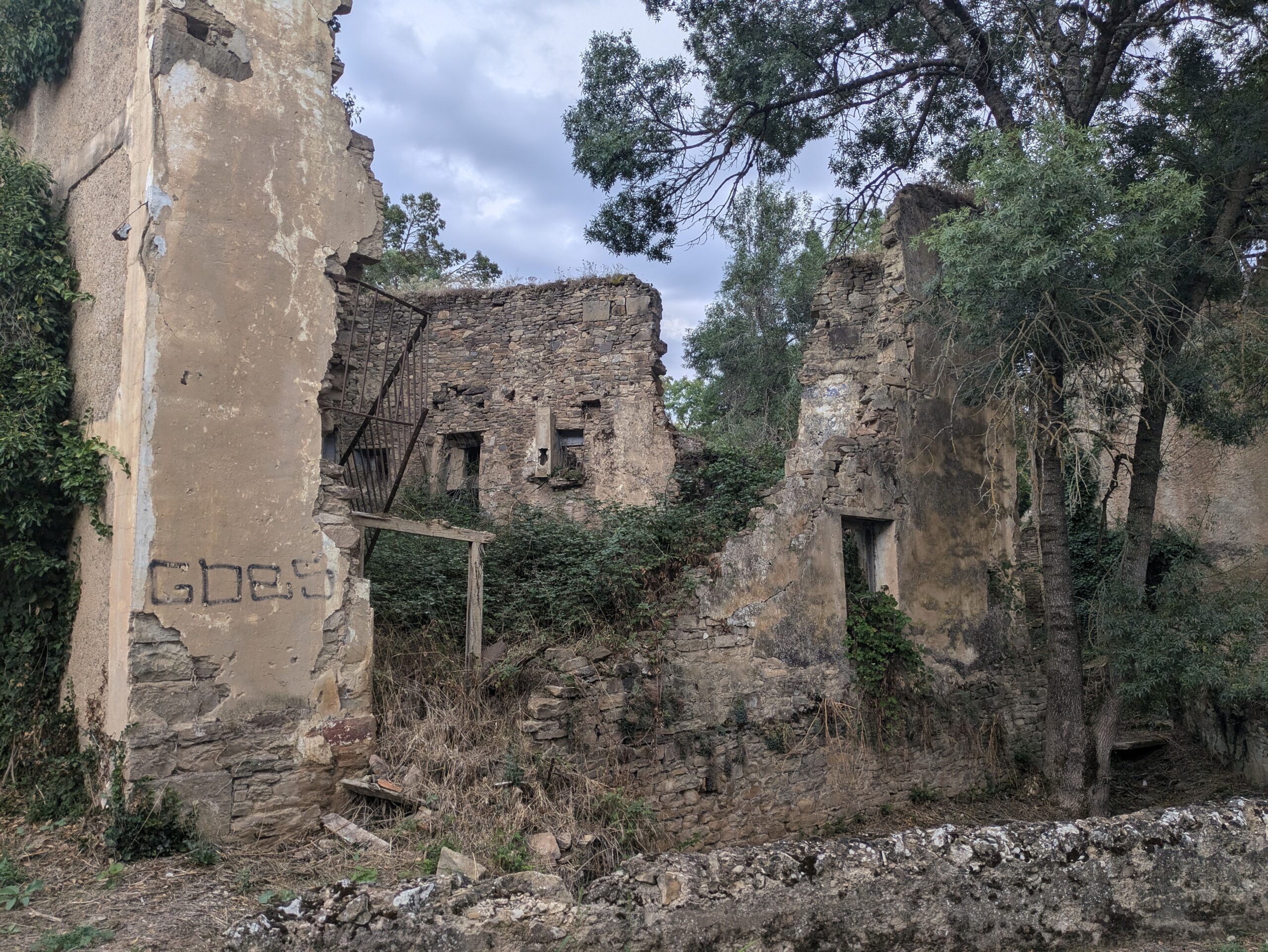
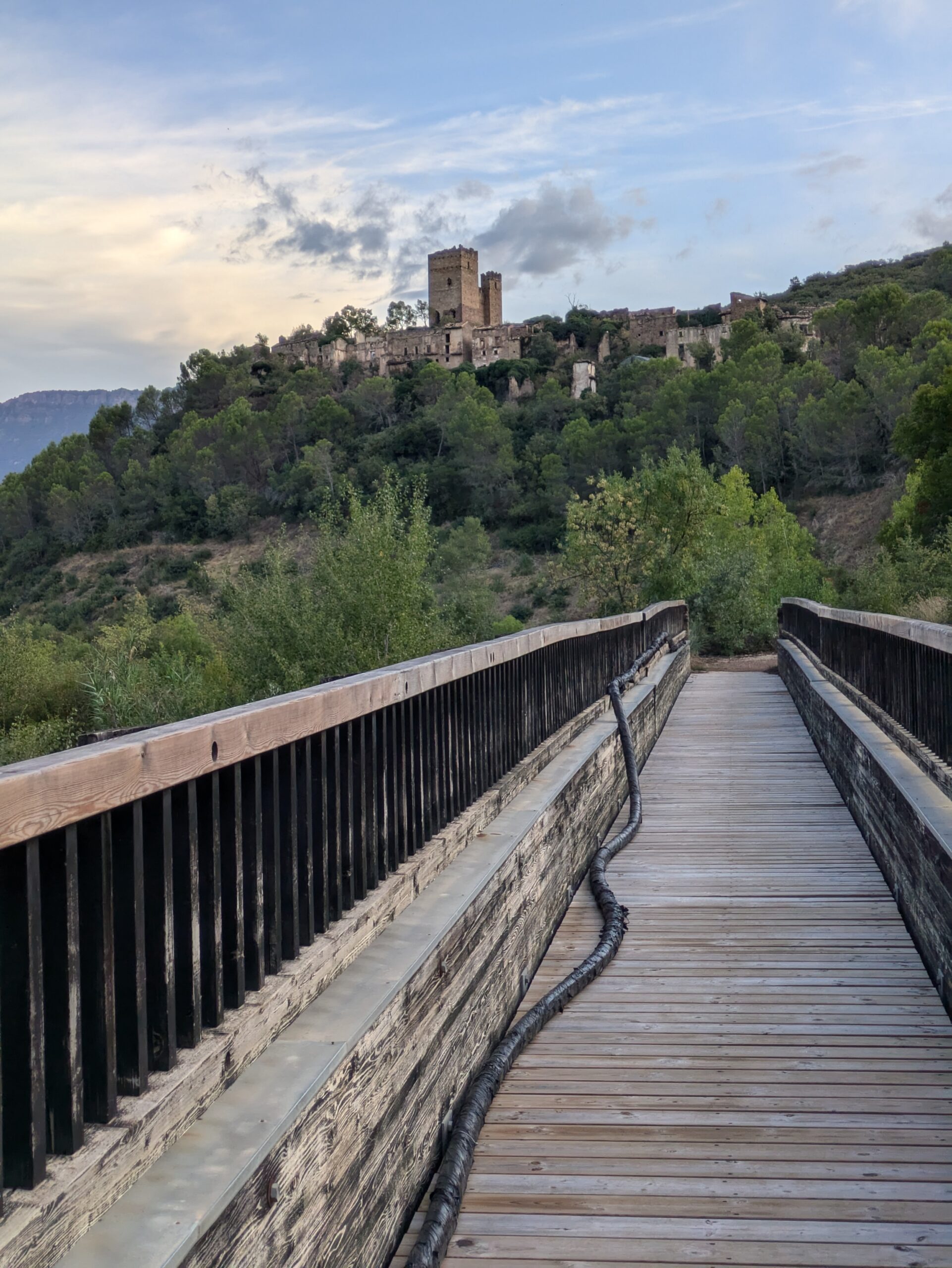
I left early the next morning, wanting to make use of the colder hours to get the most of the kilometres in, because there wouldn’t be a lot of shade on the way. Around ten in the morning, I found two of the other pilgrims at a little bar, having breakfast. I joined them, and we walked on together for a while afterwards. It was a nice experience to walk with other pilgrims for a change. We eventually dispersed again, each of us walking on at our own pace as we crossed from Aragon into Navarra. And it was quite clear that we had indeed entered Navarra, because the first thing I saw when I entered the city of Sangüesa was a bullfighting ring. On the way towards it, I spent some time mulling over the concept of pain, and hurt, and rewards. I had listened to a podcast a few days before, where someone mentioned that, ‘it has to hurt a little bit in order to get to learn yourself better’, and I wasn’t sure if I agreed with that statement. So I spent like 5 kilometres, which is a little over an hour of walking, by the way, thinking about it and how it applied to my own life. If you think that hiking the camino is physically exhausting, I can assure you that the emotional labour is twice as intense**.
**I also didn’t get to an actual conclusion on all my thoughts, because I was certain that it didn’t have to hurt for me in order to find myself – I wasn’t suffering from blisters or painful muscles, and I still learned a lot about myself – only to realise later in the day that I was making it extremely difficult for myself mentally. So… yeah.

The Arres albergue part had me tearing up 🥹 Paco and Juan sound like gems of human beings <3 <3
We've talked about it before already but reading why you did this camino here again makes me feel so proud of youuuu
On the topic of whether it should hurt to get to know yourself better, I think it doesn't always have to hurt but it sometimes definitely will! It's funny I'm reading this now, when I just finished a poem about this concept. My two cents: in order to grow as a person and get to know yourself better, you're gonna need to face your fears and revisit old trauma etc. That is a very emotional process and emotions and can be just as painful to work through as physical pain. Like, knowing yourself better requires healing your old wounds and that will hurt, just like treating a real festering wound would hurt. But ofc another part of knowing yourself is also finding out what you enjoy and that doesn't need to be a painful process at all!