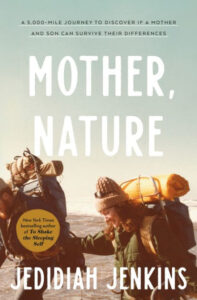
Where to start with this one. I found this title on one of those Goodread lists that I like to browse because God forbid I’d miss the existence of my next favourite book. Anyway, Mother Nature was added to Must Read Books during Pride Month. As soon as I read the blurb I was sold, although it was mostly because I read the blurb wrong and had different expectations going in.
Mother Nature is described as a book about a son and a woman and a how a relationship between the two can be saved. Jedidiah Jenkins is the son of Barbara and Peter Jenkins, two American authors who are famous for their book series A Walk Across America – a series that, as you can imagine, is about their walk across America. For three years, Barbara and Peter walked from Louisiana to Oregon. Peter actually started earlier, in New York. Their goal was simple: get to know the real America. The people who make the country. Peter meets Barbara in Louisiana, where she’s studying at the University of New Orleans. They get married and together they continue their journey. They’re both devout Christians.
Almost forty years later, Jedidiah writes his book. He’s a forty-year-old gay man, and he continuously struggles with the relationship with his mom. His sexuality and her religion make for a troubled kind of love. In an attempt to get to know his mum better, and – in a way – to allow her into his life, Jedidiah proposes a trip through history. Originally, I interpreted this as them following that hike from forty years ago. A hike with your Christian mother with the goal of talking about your sexuality? I thought. Cool! Sign me up. The aspect of nature drew me in even more, and I was already envisioning this story as one of these I-Found-Myself-There kind of stories. There’s a 98% possibility that this was fuelled entirely by the fact that I’m planning to hike 1000km myself in less than two months.
Anyway. Jedidiah and his mom don’t hike – which, honestly, makes a lot of sense because his mum is sixty-something years old and they’re going on a two-week vacation. Retracing a three-year hike is kind of… impossible. But the point is that Jedidiah and his mum do a road trip instead where they do retrace the steps of Barbara and Peter. Jedidiah has several goals during this trip, but the most pressing one is this: he wants to know if his mum would come to his wedding when he married a man.
Reading this book as a queer person wasn’t always easy. Barbara Jenkins could possibly be the sweetest, most loving person on Earth. Still, she openly admits to her son that every night she prays that he won’t be gay anymore. However, it is also clear how these words come from a deep-rooted love for her son.
I personally don’t like Christianity, or the Catholic Curch. I was baptised as a child and did my confirmation, but I never held strong ties to the church or the institution. My earliest memory of the Church is probably this one: there’s this sentence they say during our services that goes ‘Lord, I’m not worthy to receive you, but say the word and I shall be healed’. When I think of the Catholic Church, I think of my mum, sitting next to me during the service and furiously whispering, “You are worthy.” Even now, when I attend a service during a baptisement or a confirmation, I keep my mouth shut when that sentence is said. Another memory – or feeling, perhaps – I have is a way more recent one. As a child, maybe like any other child, I used to picture my wedding sometimes. As a young kid, the setting was almost always a church, for the simple reason that that was all I knew. The older I grew, the more the setting slowly morphed into a forest or a field by the lake. Still, there’s a distant hurt whenever I realise that where I once saw this field-by-the-lake as a choice, it no longer is. If I want to marry, I won’t be allowed to marry in a church. Or, rather, I will be allowed to have a service, but one that won’t recognize the relationship between me and my partner. And that hurts.
So, I don’t like the Catholic Church, and I have the feeling that the Catholic Church probably doesn’t like me that much either. And when someone doesn’t like you, when someone doesn’t recognize you or doesn’t allow you to belong, the easiest way to deal with that – for me – is shrugging my shoulders and saying, “your loss,” in the most bitter, angry, petty way ever. In my eyes, people who strongly believe in the Catholic Church, people who believe that their God would not allow me entry to Heaven because I fell in love with a woman, are inherently evil and bitter. I never linked their behaviour with love. Or at least, if I did link it with love, it became this kind of wrecked, spoiled love where a parent sends their kid to conversion therapy out of fear for the anger and the danger they’ll have to face if they live authentically. Which, by the way, is not a kind of love I can accept. Or rather, I accept that you might experience fear for your child because it is a simple fact that (gender)queer people aren’t as safe as cis- and hetero people. But acting on this fear by… creating more danger for your kid? Big nope.
Either way, the way that Jedidiah Jenkins portrays his mother is not this kind of twisted love… She is love. She is kind and she’s sweet, and even though she’s mere words on a page you can almost feel her motherly hug if you close your eyes. She’s not evil, or bitter, or angry. She doesn’t fit in that idea I have of (sorry to stereotype, but,) American Christians. Reading Mother, Nature, made me re-think a lot of stereotypes, a lot of ideas and prejudices I had built up in my head.
I have mad respect for Jedidiah, for being able to portray this love as the multi-faceted emotion that it is instead of turning it into something that can only be purely good or purely bad. He wonders if maybe there’s another option besides going for total ex-communication of parents who don’t accept their queer child. (I’d like to make the side-note here that, of course, this is
- a personal choice, always.
- safety is always the priority – both mental and physical.
- Jedidiah literally says that he could only reach this point because he moved to the other side of the country. As a kid born and raised in Belgium, this essentially means the other side of the continent.)
What’s more, I realise as well that this is potentially a view that is much easier to accept and think about, maybe even romanticize, if you grew up in a supportive family and never had to face conditional love.
Jedidiah drives his point home by using a very interesting metaphor. The book starts with the story of the four blind monks and the elephant. It’s a pretty well-known story about four blind monks who meet an elephant, and they each touch a different part of the animal. Afterwards, they try to explain to each other what the animal must look like, and they end up in a giant fight because everyone has a completely different idea of what this elephant must look like. One felt the trunk, and has decided it’s must be a snake-like animal, another one felt the leg and to him the animal is like a tree, giant and strong. Every chapter in Mother, Nature has a picture of what this elephant could look like based on the descriptions of the monks. And in the end, Jedidiah says this: “It’s a promise to my mum that I will believe in the whole elephant, even if I can’t see it. And an invitation to her to believe in it for me, too.”
Jedidiah and his mum might not reach a consensus about their religion and their sexuality, but in a way that is beautiful as much as it’s bitter, they don’t have to. Because they both see only a part of the elephant, and Jedidiah ends up accepting that. It’s strong, so insanely strong, to be able to take a step back and respect that. Because you can’t make someone see a different part of the elephant if they don’t want to, but you can be hurt by it. But maybe, we can let it hurt us while accepting it. Maybe we can take a step back, see the whole elephant even if the other person doesn’t. After all, who’s to say our world view is the only one that’s “right”? We’re all so quick in judging each other, judging ourselves, but in the end we only felt the elephant’s trunk and decided that it was a snake instead.