
Disclaimer: If you thought the food poisoning was bad, just wait until you read about the hotel.
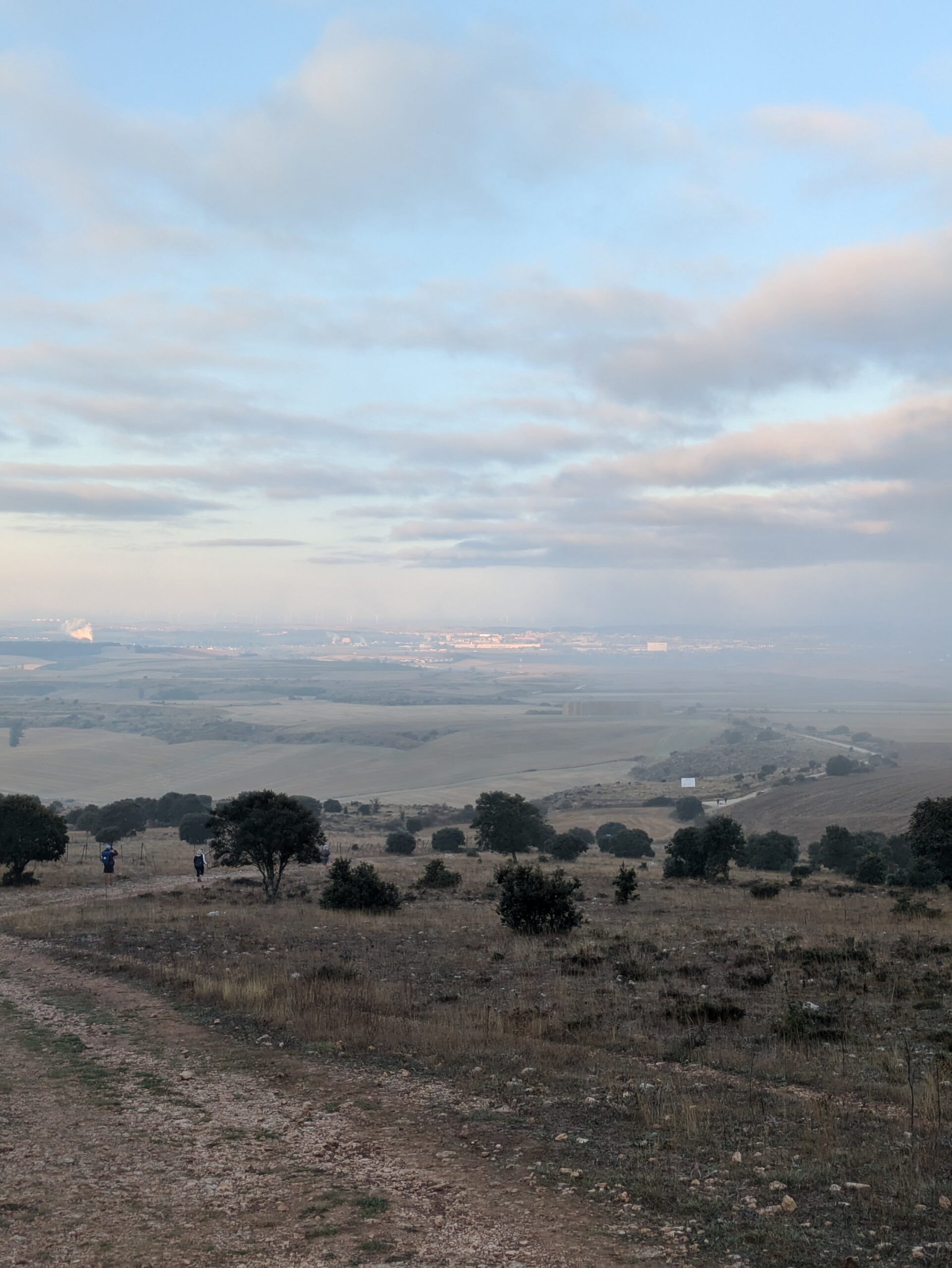
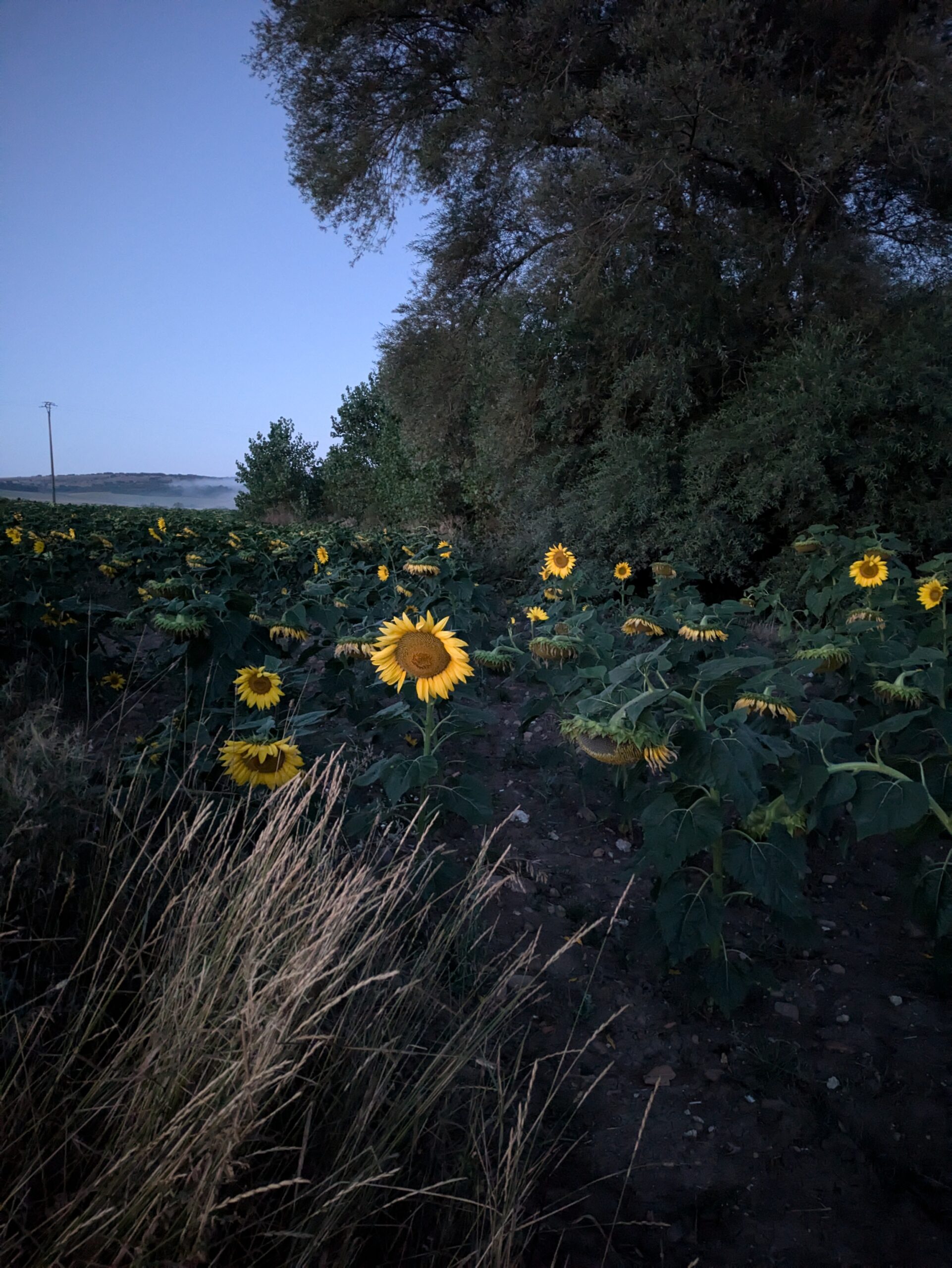
Looking back, lots of people described the stage between Ages and Burgos as one of the ugliest stretches of the camino. This is entirely due to the fact that Burgos has a very big suburb, and so the last 10-ish kilometres are effectively through industrial zones and next to two-lanes streets. It’s all a matter of perspective, though, because the first 10 kilometres easily belong to the most beautiful ones I’ve experienced so far. It was a foggy morning, and the road led up slightly towards a hill, which made it so that at some point I was walking in the clouds, and eventually higher than them. The higher the hill went, the foggier it became and the less people I saw around me. By the time I reached the top, I couldn’t see anyone before or after me. Curiously, it didn’t feel lonely or scary, rather, I felt at ease and strong. There is something about standing on top of a hill, covered by fog and old trees that makes you feel like you did something special, something that not many people experience.
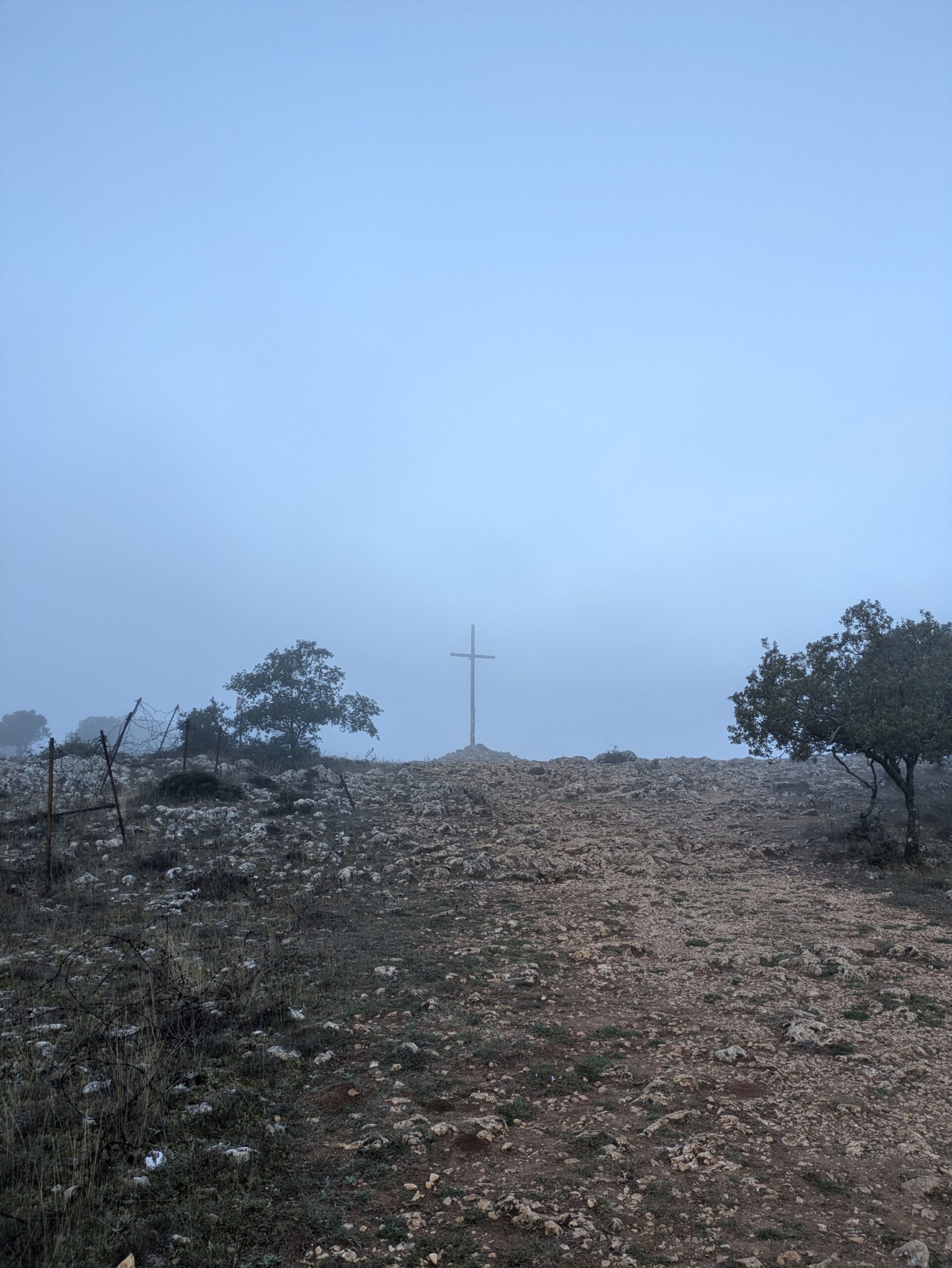

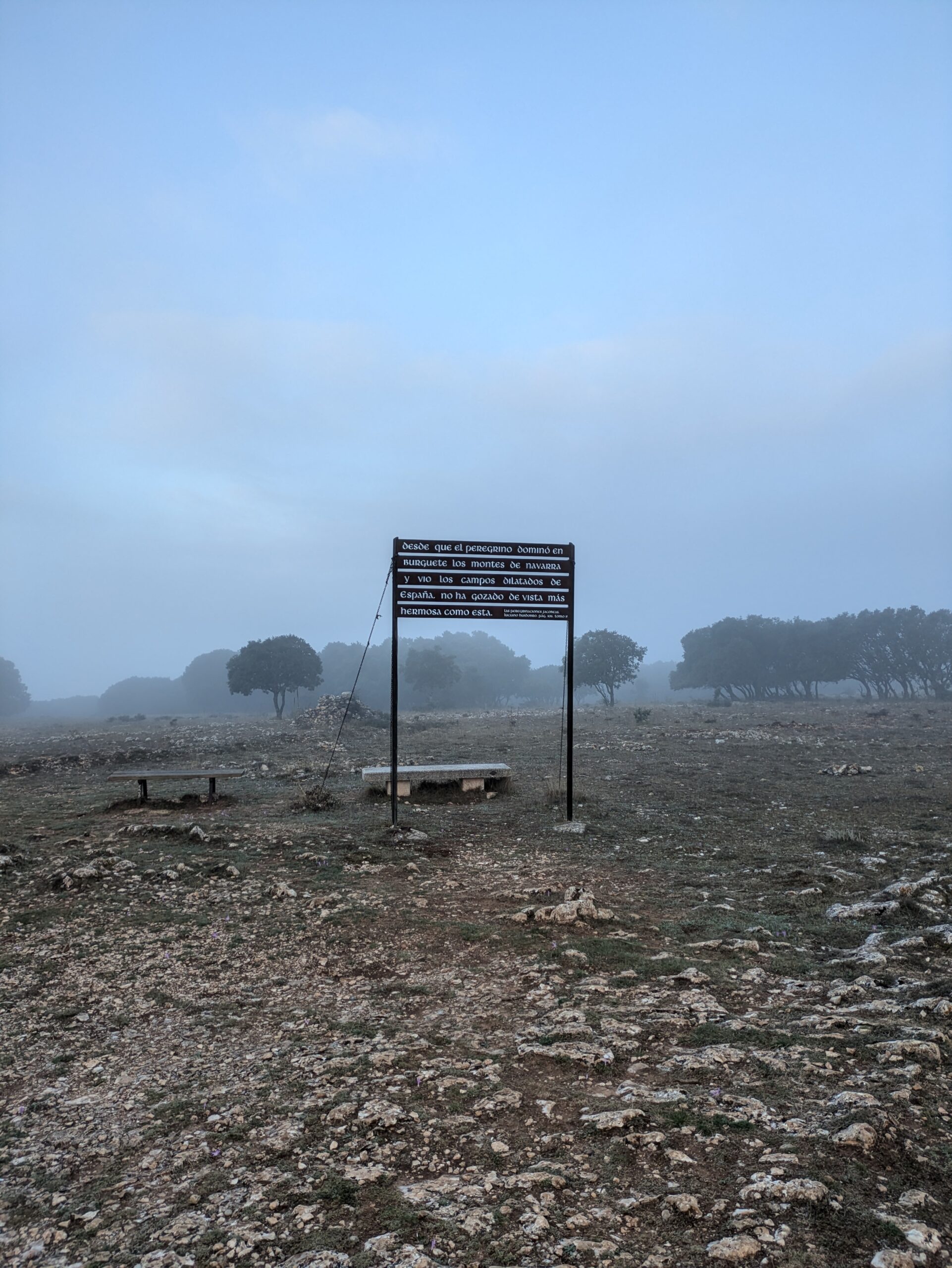
The top of the hill was adorned with the mandatory cross and a plaque that read the following quote*:
“Since the Pilgrim dominated the mountains of Navarra in Burguete and saw the vast fields of Spain, he has not enjoyed a more beautiful view than this one.”
The quote makes it quite clear that there is probably some sort of panoramic view, one that was hidden for me. Still, I do agree with the plaque and its words; up there on that hill before Burgos, I had one of the most beautiful sceneries surrounding me.
After the hill, the road nosedived back down towards the towns, where I had a little breakfast that I ate very cautiously, unsure still if my stomach would accept the food as a token of my love, or see it as a war threat. It chose the first one (yay!), and I happily continued further towards Burgos. There was a branch that split off towards the river bed. Most pilgrims followed this one, but due to a lack of facilities (read: toilets), I eventually decided on sticking to the main road and entering Burgos through the suburbs. This also meant I didn’t see anyone for the remaining 15km it took me to enter Burgos. To keep myself occupied I called some friends and then my mum, and in the blink of an eye I arrived in the city centre. I dropped my bag off at the hotel desk while I waited to get checked in, and ventured back out into the city to get some sight-seeing in. The cathedral of Burgos is overwhelmingly big and beautiful, and known for its grandeur on the camino.

Well, to be honest, most of the cathedrals on the camino are… out-of-the-pocket-big. I guess that’s what happens when cities are built to offer facilities and places of worship/prayer to the countless pilgrims that have been walking on the camino since the mediaeval times. The cathedral has an official name that is extremely long, and up until five seconds ago I didn’t even know cathedrals could have “official names”. The start of its construction began way back in 1221, and although it was opened for use in 1230, it would take roughly 300 more years for the construction to be finalised. There’s countless chapels and tombs in the walls of the cathedral – as one of my friends mentioned when we were walking through the cathedral, “This is not a church, it’s a graveyard.”

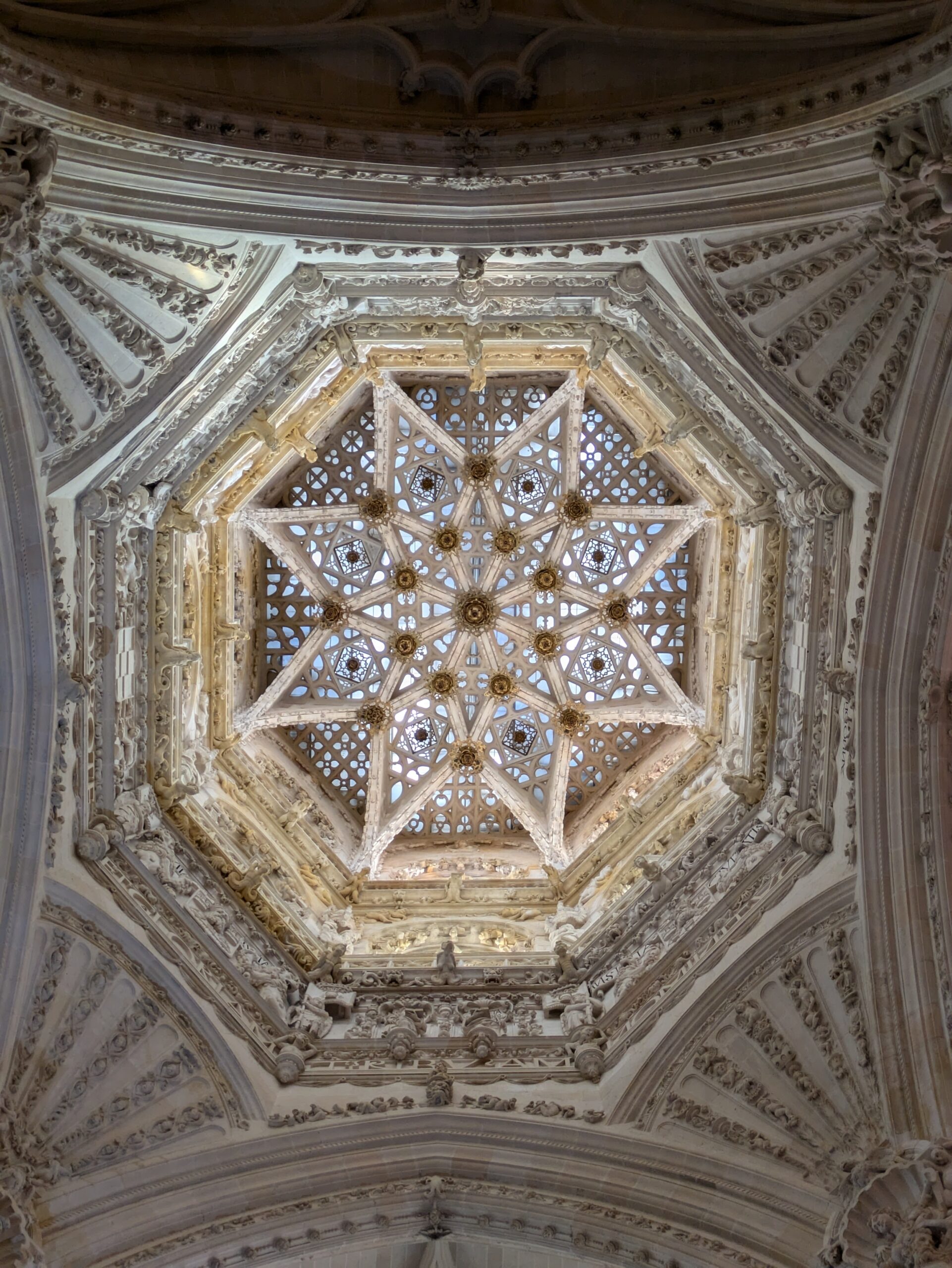

We spent the afternoon lounging in the sun by the river and chose an early evening over going out with other pilgrims (which there wasn’t a lack of, by the way, I passed quite some bars with pilgrims who were well on their way to reach peak inebriation.
I had gotten a hotel room with my own kitchen and washing machine, so I could do my laundry and make my own bland food that wouldn’t make me throw up. I did a load of laundry first thing in the morning and used my cord to create a makeshift laundry line on my little balcony so it could dry in the sun. Laundry duties done and muesli breakfast safe and well in my stomach, I set out to do my favourite rest-day activity: visiting museums. There’s a biiiiig museum in Burgos that is called the “Museum of Human Evolution” and it’s basically my paradise because not too far from Burgos is one of the biggest and most important archeological sites of Europe. Not only did they find proof that human presence in Europe was much older than anyone had thought before that point, but they also found the oldest human remains in Europe. Additionally, some of those remains bear traces of cannibalism. Cool, right?!
I spent a good four hours wandering about the places, having little freak-outs over all the cool information I found and sending my dad increasingly unhinged texts about how happy I was to see Really Old Bones. When I left the museum, it was more out of necessity than out of free will; museums in Spain have siestas too, so it closed for the afternoon and would re-open in the evening.

As is custom in most big cities, I was greeted by very loud sirens as soon as I walked out of the museum. A firetruck raced by and my first thought was a laconic, “Hah, I hope that’s not my hotel,” because that’s what you think when you hear sirens (or maybe that’s just me?). It slipped my mind immediately after though, and I started the walk back to my hotel, excited for a little afternoon rest in my big, plushy bed. Only, when I neared the plaza where my hotel was, I saw a whole group of people looking up in the direction of… my hotel. And also, it smelled vaguely like smoke. My second thought was, “Oh shit, that is my hotel.”
In the end, it turned out I was quite lucky. The building that was on fire wasn’t actually my hotel, but merely the building next to it. They were built in some sort of square though, and my room was the second room next to the separating wall. Additionally, my laundry was hanging to dry on a balcony that was facing the lit-up building. The police had taped off most of the square, and after some aimless walking around I eventually went up to an officer and asked if there was any way I could enter my room. He said yes and escorted me right to the door of the building where I was instructed to come out again as soon as possible. I salvaged my laundry as much as I could, closed all my windows (RIP), and got all my important stuff out of the room (my e-reader, mostly), before walking back out and finding myself a nice cafe to waste time in.
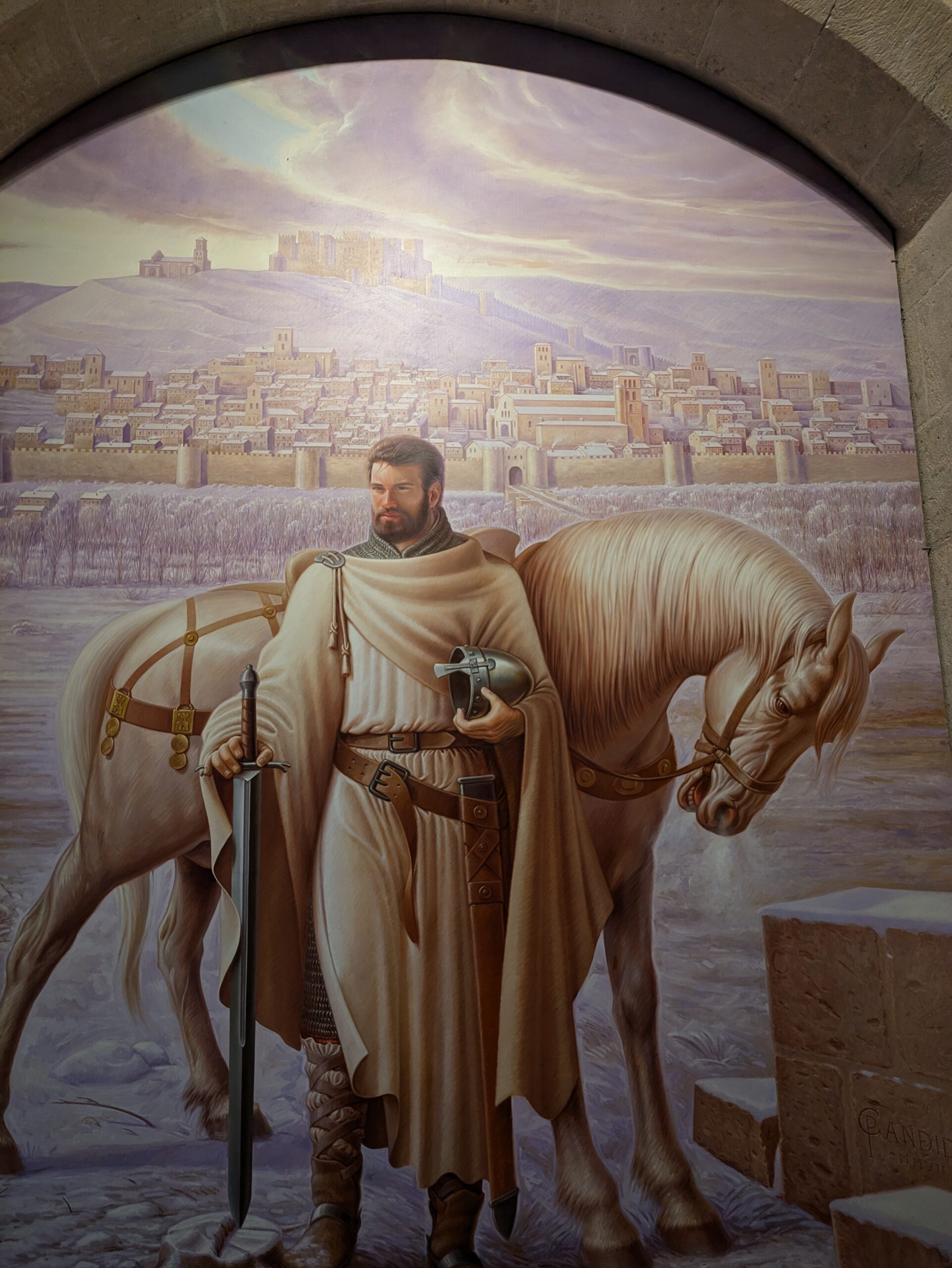

Four hours later I was still waisting time, only my mood had gone from ‘haha, what the fuck,’ to ‘I want to fucking sleep’. Note the change in emotion when the f-word is used. The cafe had thrown me out on the grounds of having taken up a chair for too long, and I had walked through the mediaeval centre of Burgos three different times. In the meantime, another firetruck had appeared, now fully blocking the entrance to my building. They were still extinguishing the fire, and the front desk of the hotel couldn’t offer any more information apart from, “we’ve got to wait.”
By seven thirty in the evening I was ready to start crying in the middle of Burgos, when I finally got the call from the hotel that I would be allowed back into my room on the condition that I wouldn’t leave it anymore for the rest of that evening. The fire had been mainly extinguished, but the roof was pretty damaged and the firefighters were in the process of throwing the damaged roof tiles down to the ground. Leaving the hotel meant potentially getting hit in the head with a roof tile. I really didn’t mind, because all I wanted at that point was my bed, so I happily agreed with the terms and was brought up to my room. After a sniff-test I determined there wasn’t really a smell of smoke in the room. Another sniff-test told me my laundry was absolutely dead though, and so I put it in the machine again in hopes of having it smell a little less like a campfire. And then I waited until the wash cycle was done so I could hang it up to dry, and I took a nice, big shower to drown out all my worries, and by the time I was in the bed I had been looking forward to the entire day, it was well past ten in the evening.

In the morning, I dragged my tired body towards the camino and started hiking again. Because, frankly, what else can you do? Burgos was bigger than I thought it was, and my first kilometres were spent walking through the suburbs once again. I was astonished at the beauty of the university campus – old, mediaeval buildings that looked like they came straight out of a fairy tail – right up until I passed by an ugly, grey block that looked a bit like a decaying prison. Unsurprisingly, this block was the faculty of education. Any and all dreams I had about studying at the university of Burgos (no one gets to mention that I am no longer a student) were immediately squashed. When I stop for breakfast I meet someone my age and we walk together for a while, all the way until we reach the first city with albergues. After Burgos, the so-called meseta, or ‘plain’ starts, and it’s kind of famous on the camino for its never-ending wheat fields. It is also, as it turned out, famous for its ‘lack of facilities’. I put that between quotation marks, because this infamy gave rise to some sort of mass hysteria that caused people to suddenly book their beds in advance. In other words, by the time I arrived at the town where I was planning on sleeping, I was:
- surrounded by people who were asking me where I was staying and
- without a bed, for the very first time on my camino.

I wasn’t feeling particularly tired yet, so I walked on without too many problems and eventually reached the nearest albergue. It was an old, small building in the middle of absolute nowhere. It had a little pool in the middle of the garden, and no central heating or warm water. I let my feet soak in the little pool for a while and took out my notebook to write down some thoughts and a little poem that was maybe (definitely) inspired by the sudden change in the rhythm of my usually peaceful days. It went like this:
the cadence of my days has simplified,
solidified, until all I do is breathe and walk and
rest, the fading stars and sunrise as a guide
and as I walk, I think, and as I think, I
am, and as I am, I feel my shoulders
unfurl a little from the grounds, towards the sky
out here by the wishing well, the water numbs
my feet, the coins are shining down below and I know
I’ll walk, and think, and breathe when tomorrow comes
Then I went to take the quickest shower of my life and all but ran to my bed to warm up underneath my sleeping bag. By the time I had rested a bit, the exhaustion had caught up with me and I was feeling… not good. I’m pretty sure this is the first time where I felt uninspired and downright not up for it when I thought about hiking the next day (which is slightly ironic given the message of the poem I had written just a few hours before that). There were flyers all around the albergue about another albergue, five kilometres further down the road, with a spa especially for pilgrims. I texted the owners asking if I could reserve a bed for the upcoming night without thinking twice about it.

It wasn’t an easy decision to do so, because I came here to walk and also I carry some generational notions with me about being or not being allowed to take a break. In short: taking breaks is allowed when you’re ‘working’ on something. My break in Burgos was justified, because I had been walking for over ten days without a break and I had been sick, but taking another break, one day later? That was just greedy, nevermind my exhaustion.
But then there was the other side of the coin. The one that said, “this isn’t a race,” and “it doesn’t have to hurt,” and “vertraag, stap trager dan je hartslag vraagt*.” Taking a chance, I decided to listen to that one for once.
*Slow down, walk slower than your heartbeat asks. Line from the poem “Laat” by Leonard Nolens.
Laat
Vertraag.
Vertraag.
Vertraag.
Stap trager dan je hartslag vraagt.
Verlangzaam.
Verlangzaam.
Verlangzaam.
En verdwijn met mate.
Neem niet je tijd
En laat de tijd je nemen –
Laat.
Leonard Nolens